
Repair guide · Tulsa & the surrounding metro
Stamped Concrete Repair in Tulsa: Cracks, Faded Color and Failing Sealer
Most stamped concrete that looks ruined isn't. A washed-out patio, a white haze across the driveway, or a crack running down a control joint usually comes down to the sealer, or to cracking the slab was built to do. The right fix depends on which layer has the problem: the clear coat on top, the color in the surface, or the concrete underneath.
Where we fit, plainly: we pour new stamped and decorative concrete, install stamped overlays over sound concrete, and reseal decorative concrete. Stand-alone crack patching, spot repairs and recoloring aren't on our service list. Many of those small fixes are a weekend DIY job or work for a repair specialist, and this guide says which is which so you don't pay for more than your slab needs.
Stamped concrete repair by symptom: likely cause, fix, and who does it
Find the row that matches what you're looking at. Several of these need nothing more than a can of sealer or a can of solvent.
| What you see | Likely cause | Usual fix | Who usually does it |
|---|---|---|---|
| Faded, dull or chalky color; water soaks in and darkens the surface instead of beading | The clear sealer has worn away. The color underneath is usually still there. | Clean and reseal. A fresh clear coat often brings most of the color back. | DIY or a sealing pro. Resealing is work we do; see our cleaning and resealing guide. |
| Color still pale or patchy after a fresh clear coat | The surface color itself has worn or bleached | Tinted sealer, or water-based stain or antiquing on clean, unsealed concrete | DIY or a decorative-concrete restoration specialist. Recoloring isn't on our service list. |
| Milky, cloudy or white patches in the sealer | Moisture trapped in a solvent-based acrylic sealer as it cured (blushing) | Re-wet the sealer with xylene so it can dry clear | Often DIY, with care. Details below. |
| Sealer peeling or flaking off in pieces | The sealer lost its bond: vapor from below, coats built up too thick, or an incompatible product | Strip the failed sealer, let the slab dry, reseal thin with a compatible product | A sealing pro or a careful DIYer. Resealing is work we do. |
| A crack running along a control joint | The slab cracking where it was designed to | Usually nothing. A flexible joint sealant if you want to keep water out. | DIY |
| A random hairline crack, flush on both sides | Shrinkage or minor settling | Leave it, or fill it with a color-matched flexible filler and accept it will still show | DIY or a repair specialist |
| Chipped edges, popped-out spots, or surface paste flaking off | Freeze-thaw, deicing salt, or a weak top layer | Small spots: color-matched patch. Widespread scaling on a sound slab: a new decorative surface. | Patches: DIY or a repair specialist. A full new surface is a stamped overlay, which we install. |
| One side of a crack higher than the other, or a crack that keeps widening | The slab is moving on the soil below | Fix the cause (drainage, base), then replace the section | A replacement section is a new pour, which we do. A patch or overlay won't hold here. |
| Sections sunken, heaved, or crumbling | Base or structural failure | Tear out and re-pour | New stamped concrete, which we do. See the stamped concrete cost guide for new-pour pricing. |
"Repair specialist" here means a contractor who focuses on concrete crack, patch and restoration work, or on decorative recoloring. They are a different trade from installers like us.
Why is the sealer on my stamped concrete peeling, flaking, or turning white?
Almost every sealer failure on stamped concrete traces back to moisture, film thickness, or both. The sealer manufacturer ChemMasters splits the white problems into two kinds in its tech tip on solvent-based acrylic sealer, and the difference decides the fix.
White blushing in solvent-based acrylic sealer
Blushing is, in ChemMasters' words, "a milky appearance within the sealer itself," commonly caused by moisture trapped in the sealer as it cures. Sealing on a humid evening, before morning dew burns off, or right before the sprinklers run are the usual setups.
Here's the honest part: on a solvent-based acrylic, this is often a fix you can do yourself for the price of solvent. Xylene softens the acrylic so the trapped moisture can escape and the film dries clear again. ChemMasters' procedure is to roll xylene on at about one gallon per 300 square feet, let it dwell one to two minutes until the sealer softens, then work it back and forth with the roller like paint, repeating if the build-up is heavy. A few cautions from the same sheet and from experience:
- Know your sealer type first. ChemMasters says not to use its solvent-based procedure on water-based products. Its separate water-based sheet says success there depends on severity and time, and a badly failed water-based film that "looks like powdered sugar" can't be saved.
- Protect the accent color. ChemMasters warns to "be careful not to disrupt the accent colors in stamped concrete" when working the solvent in.
- Test a small area, and treat xylene with respect. It's flammable and the fumes are strong. Work outdoors, on a cool, overcast, still day, with gloves and eye protection, and follow the product's safety sheet.
Whitening and peeling: when the sealer on stamped concrete loses its bond
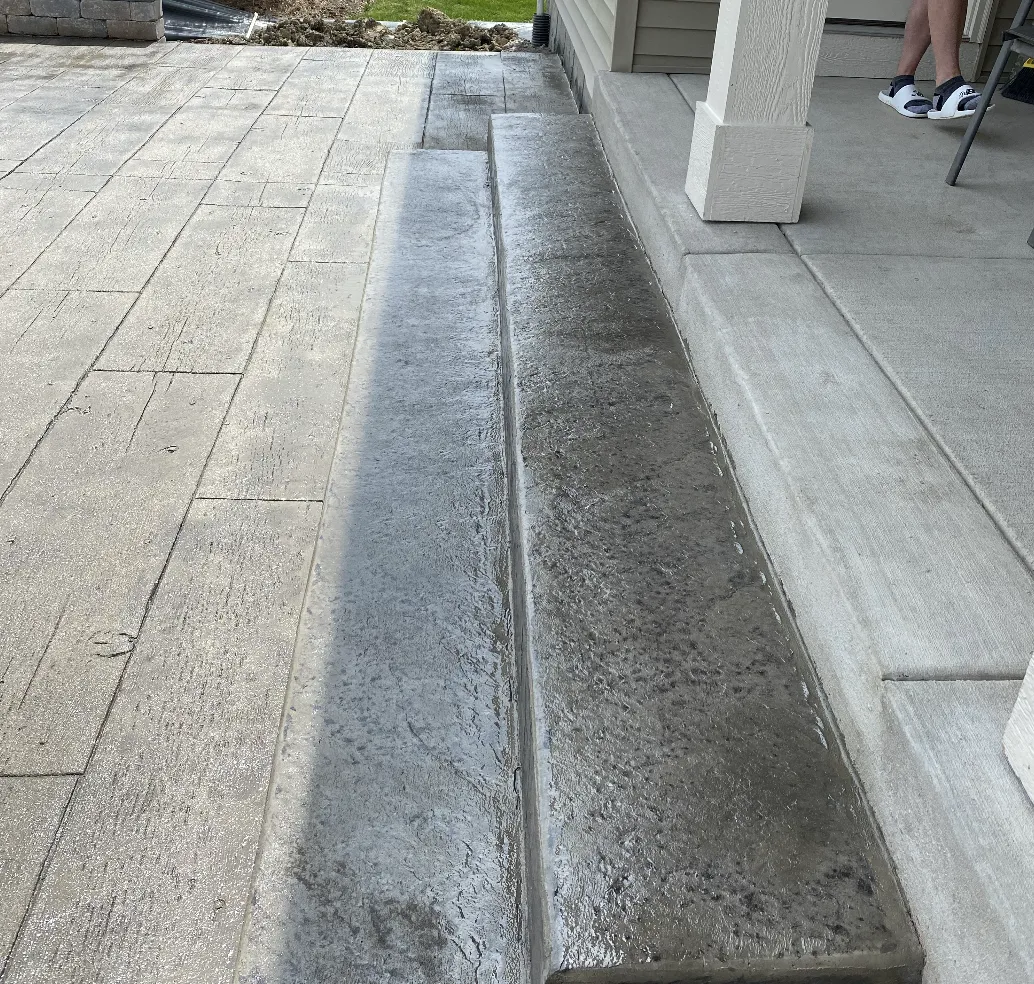
Whitening is different. ChemMasters describes it as frosted areas that show up several days after a good-looking seal job. Water vapor is always rising through concrete, and an acrylic sealer is meant to let it pass. If the sealer goes on too heavily or too often, it stops breathing, vapor condenses underneath, and the sealer lets go of the surface. It tends to be worst in full sun. Once the film is loose, it flakes and peels.
A xylene re-wet can sometimes lay a thin, lifted film back down. When the sealer is coming off in sheets, or years of coats have built up into a thick, cloudy layer, it has to come off instead.
Stripping failed sealer before the next coat
Stripping means a chemical stripper made for the sealer type, scrubbing, a thorough rinse, and enough dry time that no moisture is trapped under the next coat. Then the new sealer goes on thin, in a product compatible with whatever is left. The lesson most peeling slabs teach is that the next coat should be thinner, not thicker. Routine care after that, including how often to recoat, is covered in our guide to cleaning and resealing stamped concrete.
Can faded stamped concrete be recolored?
Yes, but try the cheapest step first, because faded stamped concrete often isn't short on color. It's short on sealer.
Why faded stamped concrete often just needs a clear coat
The Concrete Network lists enriching "the color intensity of stamped concrete" among the main jobs of a stamped concrete sealer. When the sealer wears off, the surface goes light and dusty-looking even though the pigment is still in the concrete. Try this: wet a faded spot with a hose or a damp rag. If the color comes back while it's wet, a clear reseal will likely bring back most of it. If it stays pale even when wet, the color itself has worn and you're looking at recoloring.
Tinted sealer for faded stamped concrete
A tinted sealer adds a translucent wash of color and seals in the same step. The Concrete Network suggests a tinted sealer when you want a subtle color change, and it's the least invasive recolor. Depending on the product, it may go over a compatible, well-bonded sealer or need the old coat removed first, so follow the maker's instructions. The trade-offs: it's still a sealer film, so it wears like one and will need renewing; heavy or uneven rolling shows as darker streaks; and because the color is translucent, it works best for deepening or warming a tone, not for making a dark slab lighter.
Water-based stain and antiquing to recolor stamped concrete
For a bigger change, water-based stains and antiquing put color into the surface itself, and they need bare concrete. Stain manufacturer Direct Colors' guide to recoloring faded stamped concrete is blunt about it: "strip the old sealer off completely first; stain can't absorb through a sealer." That stripping is the hard part of the job. Test your colors in a hidden corner, and judge them after sealing, since the true color doesn't show until the sealer goes on.
Honest note: recoloring isn't on our service list. A careful homeowner can do a tinted sealer, and stain recolors are a good job for a decorative restoration specialist. If you'd rather start over with a new pattern and color on a sound slab, that's a stamped overlay; our decorative concrete page explains the stain and color options we use on new work.
How do you repair cracks in stamped concrete?
First decide what kind of crack it is. Most cracks in stamped concrete are cosmetic, a few are warnings, and the repair for each is different.
Cracks in stamped concrete control joints
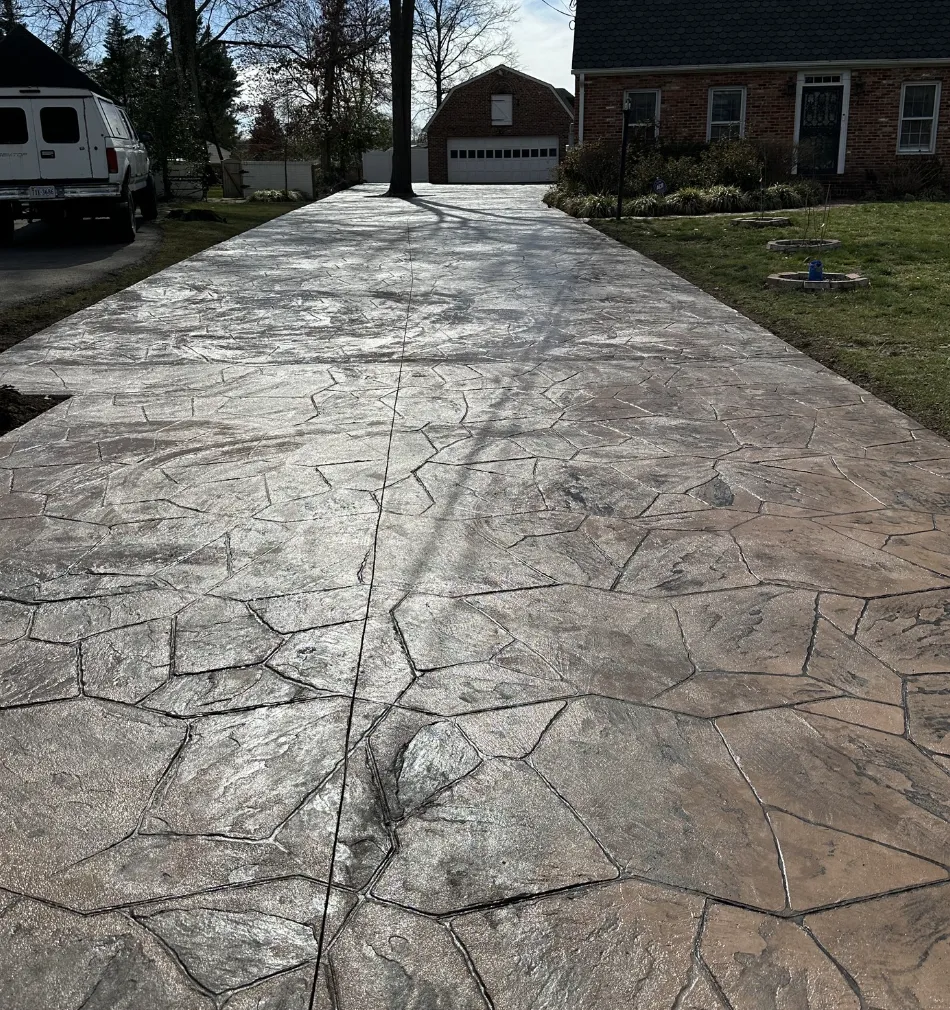
Concrete shrinks as it cures and moves with temperature, so installers cut or tool control joints to give the cracks a straight, hidden place to happen. A crack sitting inside a joint means the joint is doing its job. Don't fill it with a rigid patch, which just moves the crack somewhere else. If you want to keep water and grit out, a flexible joint sealant in a matching color is enough.
Hairline cracks across the stamp pattern
Thin cracks that wander across the texture are usually shrinkage cracks. The Concrete Network's stamped concrete repair Q&A says that "typically, shrinkage cracking is only an aesthetic issue and does not affect the structural integrity of the concrete." Leaving them alone and keeping the surface sealed is a legitimate choice. If you fill them, use a color-matched flexible crack filler, or a color patch mixed with bonding polymer, the method that same Q&A describes, and seal over it.
Why stamped concrete crack repair rarely matches
This is the part a lot of repair ads skip. A filled crack in stamped concrete almost never disappears. The patch is a different material at a different age, so it takes color differently; the Concrete Network notes that new concrete can look different from old simply because it hasn't had a chance to age. A thin line of filler also can't carry the stamp texture. On a cracked overlay, the same Q&A puts it plainly: "Chances are the crack will always show, but a good color match can minimize its appearance." Go in expecting less noticeable, not invisible.
Offset or widening cracks mean the slab is moving
A crack with one side higher than the other, one that opens wider every summer, or one that keeps getting longer means the slab is moving on what's beneath it. On expansive clay, uneven moisture is the usual driver: a downspout emptying at the slab edge, a leaking irrigation line, or a big tree drying one side of the yard. Filler won't hold, and an overlay will crack right along it. Fix the water source, then replace the moving section. Replacement sections are new-pour work, which we do.
How do you fix chips, spalls, and scaling on stamped concrete?
Scaling is the top layer of cement paste flaking away, leaving rough, pitted patches. Spalls are deeper chips and popped-out spots. Both are usually surface problems, and the size of the damage decides the fix.
Salt scaling and freeze-thaw damage on stamped concrete
Freeze-thaw is the main driver. Water soaks into an unsealed or worn surface, freezes and expands, and pops the paste loose. Deicers make it worse. The Pennsylvania Aggregates and Concrete Association's bulletin on scaling says to "never use ammonium sulfate or ammonium nitrate as a deicer as these chemicals are too aggressive and will easily destroy a concrete surface," and generally recommends no deicers at all in a slab's first year. A weak top layer from the original pour can also be the cause: the Concrete Network's Q&A notes that overfinishing can weaken the top 1/4 to 1 inch, and that concrete which froze while curing has no fix short of removal and replacement.
Chipped edges and spot spalls in the stamp texture
Small, isolated spots can be patched with a polymer-modified repair mortar, colored to blend, with texture pressed in from a matching texture skin if you can get one, then sealed. Like crack repair, patches blend rather than vanish. A few small patches on a big patio usually read fine from standing height.
When scaling is widespread on stamped concrete
Once scaling covers large areas, spot patching turns into a quilt. If the concrete underneath is sound and the slab isn't moving, a new decorative surface bonded over it is the practical fix, and that's the work our stamped overlay page covers. If the concrete under the scaling is soft or crumbling, there's nothing sound to bond to, and replacement is the honest answer.
Reseal, recolor, overlay, or replace stamped concrete: which one fits?
The four ways forward, from least to most involved. Pick the lowest row that actually solves your problem.
Our honest read: if the color comes back when the slab is wet, start with a reseal. If the color is genuinely gone but the surface is intact, recolor. If the surface itself is wrecked but the slab sits flat and still, overlay it. Only a slab that is moving or crumbling needs to come out. We don't publish prices for stand-alone repairs because we don't do them; resealing and new-pour costs are on the maintenance and cost guides linked above.
What Tulsa weather and clay do to stamped concrete
Three local forces cause most of the damage in the table above. Temperatures are 1991–2020 normals from the National Weather Service Tulsa climate summary.
Summer heat and sun wear sealer thin
Tulsa's average July high is 93.6°F, with about 74 days a year at or above 90°F. Long, hot, sunny seasons break down sealer film, which is why faded color is the most common complaint and a reseal is the most common fix.
Freeze-thaw and deicers cause scaling
Tulsa averages about 72 days a year at or below freezing, between an average first freeze of November 3 and last freeze of March 29. Every freeze on a wet, unsealed surface works at the top layer, and harsh deicers speed it up. Plain sand gives traction without the chemistry.
Clay movement causes offset cracks
Expansive clay swells when wet and shrinks as it dries. When one edge of a slab stays wetter than the rest, from a downspout or irrigation, that edge moves and the slab cracks. Those are the cracks no patch or overlay fixes until the water is managed.
Who should fix your stamped concrete?
Matching the job to the right person saves real money. Roughly:
Stamped concrete fixes you can do yourself
- Clean and reseal a faded slab with a compatible sealer.
- Clear white blushing in solvent-based acrylic sealer with a xylene re-wet.
- Run flexible sealant in open control joints.
- Fill a few hairline cracks with color-matched filler.
- Roll on a tinted sealer, after testing a corner.
Stamped concrete repair specialists
Color-matched crack and spall repair, texture touch-ups, stripping heavy sealer build-up, and stain or antiquing recolors. Ask to see their own repairs on stamped work, and expect them to tell you a repair will blend, not vanish.
Our part: overlays, new stamped concrete, and resealing
When a slab is sound but the surface is past saving, we install a stamped concrete overlay. When it's moving or failing, we tear out and pour new stamped concrete patios, driveways and walks. And we reseal decorative concrete. If your slab only needs a reseal or one of the DIY fixes above, we'll tell you that. For a worn pool deck, our pool deck resurfacing guide covers the deck-specific problems.
Overlay or Replacement Estimate
Tell us what your stamped concrete is doing. If it needs a new surface or a new pour, we'll quote it. If a reseal will do, we'll say so.
Thanks — request received!
We'll reach out shortly about your stamped concrete. For anything urgent, call (918) 505-7730.
Stamped concrete repair questions
Often, yes, if it's a solvent-based acrylic sealer. Rolling xylene over the cloudy area softens the sealer so trapped moisture can escape and the film dries clear. Sealer maker ChemMasters' procedure uses about one gallon per 300 square feet with a one-to-two-minute dwell. Test a small spot first, protect the accent color, and use proper ventilation and protection. Water-based sealers don't respond the same way, and sealer that is peeling off in sheets needs to be stripped instead.
Rarely perfectly. The filler is a different material and age than the slab, so it takes color differently, and a thin line of patch can't carry the stamp texture. A good color match makes the crack much less noticeable, but expect to still see it up close.
For stain or antiquing, yes. Stain has to soak into bare concrete and can't absorb through a sealer. Some tinted sealers can go over a compatible, well-bonded sealer, depending on the product's instructions, but never over sealer that is peeling or cloudy. Test any recolor in a hidden corner and judge it after it's sealed.
Not with a rigid patch. Control joints are where the slab is designed to crack and move, and a hard filler just pushes the crack somewhere else. A flexible joint sealant in a matching color keeps water and grit out while letting the joint keep working.
If the slab sits flat and isn't moving, it's almost always worth saving: a reseal, a recolor, or a stamped overlay costs less than demolition and a new pour. Replacement makes sense when sections are heaved, sunken or crumbling, or cracks keep widening, because any repair or new surface will follow the slab's movement.
Not as a stand-alone service. We pour new stamped and decorative concrete, install stamped overlays over sound slabs, and reseal decorative concrete. If your slab needs an overlay or replacement, we can quote it. Small crack patching, spot repairs and recoloring are usually DIY jobs or work for a repair specialist.
Sources used in this guide: ChemMasters, repairing whitening or blushing of solvent-based acrylic sealer; ChemMasters, water-based acrylic sealer; Concrete Network, repairing stamped concrete problems; Concrete Network, making new concrete match old; Concrete Network, stamped concrete sealers; Direct Colors, recoloring faded stamped concrete; Pennsylvania Aggregates and Concrete Association, scaling; NWS Tulsa climate normals.
Stamped concrete past the point of repair?
If your slab needs a new stamped surface or a new pour, we'll come out, check whether it's moving, and give you a straight answer and a firm price. If a reseal or a DIY fix will do, we'll tell you that instead. Serving Tulsa and the surrounding metro.