
Tulsa & the surrounding metro
Pool Deck Resurfacing in Tulsa: Reseal, Recoat, or Replace?
A tired pool deck usually isn't a ruined one. Most are faded, a little slick, cracked in a few predictable places, or wearing an old coating that has started to flake. Whether yours needs a reseal, a new surface, or a jackhammer depends on what's going on underneath the finish, so start with three questions:
- Is the slab moving? A raised lip at a crack, a section that has sunk toward the pool, or a crack that opens wider every summer means the problem is below the surface. No coating or overlay fixes that by itself.
- Is the problem the surface or the concrete? Faded color, a slick feel when wet, peeling sealer and a flaking coating are surface problems, and they're what resurfacing is for. Concrete that crumbles when you scrape it is a different job.
- Is the coping involved? If the joint between the deck and the pool coping has split open, coping stones are loose, or the pool is losing water, call your pool contractor before anyone touches the deck.
If the slab is stable and the trouble is on top, we resurface pool decks with a bonded stamped or textured decorative overlay. Repairing cracks, prepping the surface, adding color, and sealing with an anti-slip additive are all part of that job. If a plain reseal is all your deck needs, we'll tell you that instead.
Have Your Pool Deck Looked At
Tell us what the deck is doing. We'll come out, look at it, and tell you which fix makes sense.
Thanks — request received!
We'll reach out shortly about your pool deck. For anything urgent, call (918) 505-7730.
Resurface, recoat, or replace your pool deck?
Match what you're seeing to the row below. The right-hand column says whether it's work we do, and it says so honestly when the answer is no.
| What you see | What it usually means | Usual fix | Our part |
|---|---|---|---|
| Faded color, chalky surface, slick when wet | The sealer has worn out. The concrete hasn't. | Clean and reseal, with an anti-slip additive | Yes. It's also the cheapest fix on this page; see our cleaning and resealing guide. |
| Cloudy white patches or peeling sealer | Moisture trapped under the sealer, or too many coats built up | Strip the failed sealer and reseal | Yes, as part of a reseal. |
| Plain broom finish or worn pebble deck that's sound but dated | Nothing structural, just a tired surface | Decorative overlay or a coating | Yes. A stamped or textured overlay is our resurfacing method. |
| Hairline cracks, small spalls, pitting | Shrinkage cracks, freeze-thaw scaling, surface wear | Repair cracks and patch spalls, then resurface | Yes. That repair work is part of our overlay prep. |
| An old spray deck or cool-deck coating chipping and flaking | The coating is losing its bond | Recoat with a similar system, or remove it and overlay | We do the overlay route. Recoating with the original system is a coating applicator's job. |
| A raised lip at a crack, or a section that has sunk | The slab is moving on the soil underneath | Fix or replace that section first | We'll say plainly that an overlay won't hold here. Replacement sections are new-pour work. |
| Cracks wider than about 1/4", spreading or offset, crumbling edges | A structural or base failure | Tear out and re-pour | That's a new stamped concrete pool deck, not resurfacing. |
| Split joint at the coping, loose coping, cracked tile line, water loss | A pool-structure or expansion-joint problem | Pool contractor first | Not our work. Get it fixed before any deck work starts. |
The 1/4-inch guideline comes from the Concrete Network's pool deck resurfacing guide, which also notes that an overlay "bonds to the existing slab, so it can't fix problems below the surface." We agree with both.
Pool deck coatings compared: spray deck, cool deck, paint, sealer, and stamped resurfacing
"Pool deck coatings" covers very different products. Some are a few mils of paint, others a bonded layer of polymer-modified cement. Here's what each one is, how it feels underfoot, and where it tends to fail. We don't install every one of them, and the last column says which.
| Option | What it is | Underfoot | Weak spots | Do we install it? |
|---|---|---|---|---|
| Clear sealer (reseal) | A fresh coat of sealer over the existing surface | Same as the deck today. An anti-slip additive improves grip. | Doesn't hide cracks or change texture. Needs renewing every few years. | Yes |
| Paint / epoxy-type deck paint | A thin film coat rolled or sprayed on | Can be slick without grit. Dark colors run hot. | Concrete Network says paint "may need reapplying in as little as a year." Peels where moisture pushes up from below. | Not on our service list |
| Acrylic spray texture ("spray deck," knockdown) | A thin acrylic or polymer-modified cement coat, sprayed on, knocked down with a trowel, then topcoated | Fine texture. Light colors stay comfortable. | Chips need prompt touch-up or water gets under the coating. Being thin, it shows cracks in the slab. | Not on our service list |
| Cool-deck coatings | A light, textured cement-based or acrylic finish sold for barefoot comfort. Kool Deck is one trademarked brand, and "cool deck" gets used loosely for most knockdown finishes. | Marketed to stay cooler than bare concrete | Patches are hard to color-match, and repairs go best with someone who knows that specific system. | Not on our service list |
| Stamped / decorative overlay | A bonded polymer-modified overlay, stamped or textured, colored, and sealed | Textured stamp plus anti-slip sealer, in light colors | The priciest of the resurfacing options. Can't fix a moving slab. Needs periodic resealing. | Yes, this is how we resurface |
| Pavers over the old slab | Pavers set on top of the existing concrete | Depends on the paver color | Raises the deck height, which can clash with the coping, door thresholds and drainage. Joints can shift. | Not on our service list |
Our honest read: if your deck is sound and you like a fine sprayed texture, a coating applicator will usually come in cheaper than our overlay, since Concrete Network ranks a stamped overlay as the most expensive resurfacing choice. An overlay earns its price when you want a slate, stone or tile texture, a thicker wearing surface, or a way out of repeated touch-ups on a coating. For the same look on patios, walks and driveways, see our stamped concrete overlay service.
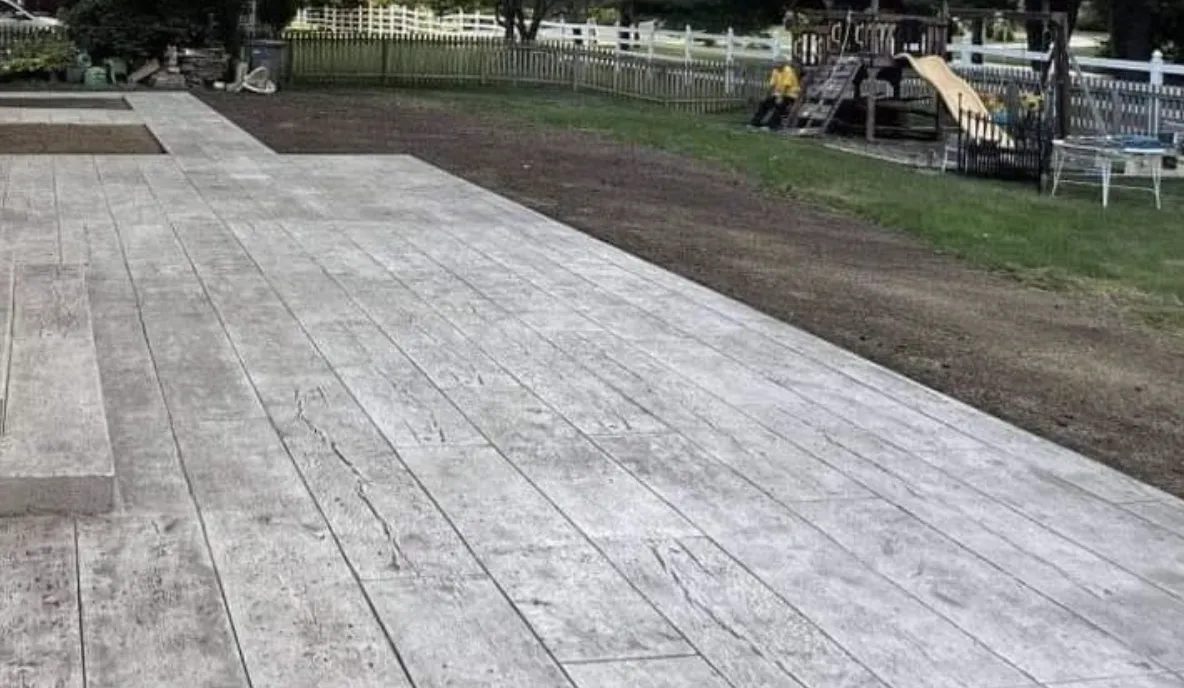
Cool deck resurfacing: recoat it or cover it?
Cool-deck and spray-deck finishes are easy to spot: a light, fine knockdown texture, often tan or off-white. As they age, they chip near the waterline, stain, fade unevenly, and show every patch. There are two honest ways forward.
Recoat it when the existing coating is still well bonded across most of the deck. Clean it, patch the chips, and apply a new texture coat and topcoat of a compatible system. That's coating-applicator work, and it's usually the less expensive route.
Cover it when the coating is letting go in many spots, sounds hollow when tapped, or you're done with touch-ups. Nothing bonds well to a coating that is coming loose, so we remove the loose material, grind down to sound concrete, repair the cracks, and bond a stamped overlay to the slab itself.
What we won't do is lay an overlay over a delaminating coating to save a day of prep. An overlay is only as strong as whatever it's stuck to.
Pool deck repair: cracks, spalls, and heaved sections around the coping
Every resurfacing job is really a repair job first. The new surface only lasts as long as the deck under it, so here's how the common problems get handled and which ones end the conversation about resurfacing.
Hairline and shrinkage cracks
Thin, stable cracks get cleaned out and filled before the overlay goes down. Existing control joints are carried up through the new surface rather than buried, because concrete will crack at a joint whether you can see the joint or not.
Spalls, pitting, and scaling
Freeze-thaw cycles, deicing salt tracked from the driveway, and salt-water splash all pop small chips out of the surface. Loose material is removed down to sound concrete and the spots are patched so the overlay sits on a solid, even base.
Heaved or sunken sections near the pool
A section that has lifted or dropped is moving on the soil below, and an overlay will follow it. That section has to be stabilized or replaced first. One honest caution: when the concrete closest to the pool sinks, the cause is sometimes water washing out the base. Before anyone repairs the concrete, ask your pool company to check the plumbing under the deck for leaks.
When an overlay will telegraph cracks
A crack that is still moving, whether it opens in August and closes in January, keeps lengthening, or has one side higher than the other, will eventually show through any overlay or coating. We'll point those out during the estimate instead of letting you find them next spring. Sometimes the right answer is to replace one bad section and resurface the rest.
Coping and the expansion joint belong to your pool contractor
The flexible joint between the deck and the pool coping lets the deck and the pool shell move independently. An overlay should stop at that joint and never bridge it. Re-caulking that joint, resetting loose coping, and repairing the tile line are pool-contractor work, not ours, and they should be done before the deck is resurfaced so the new surface isn't disturbed afterward.
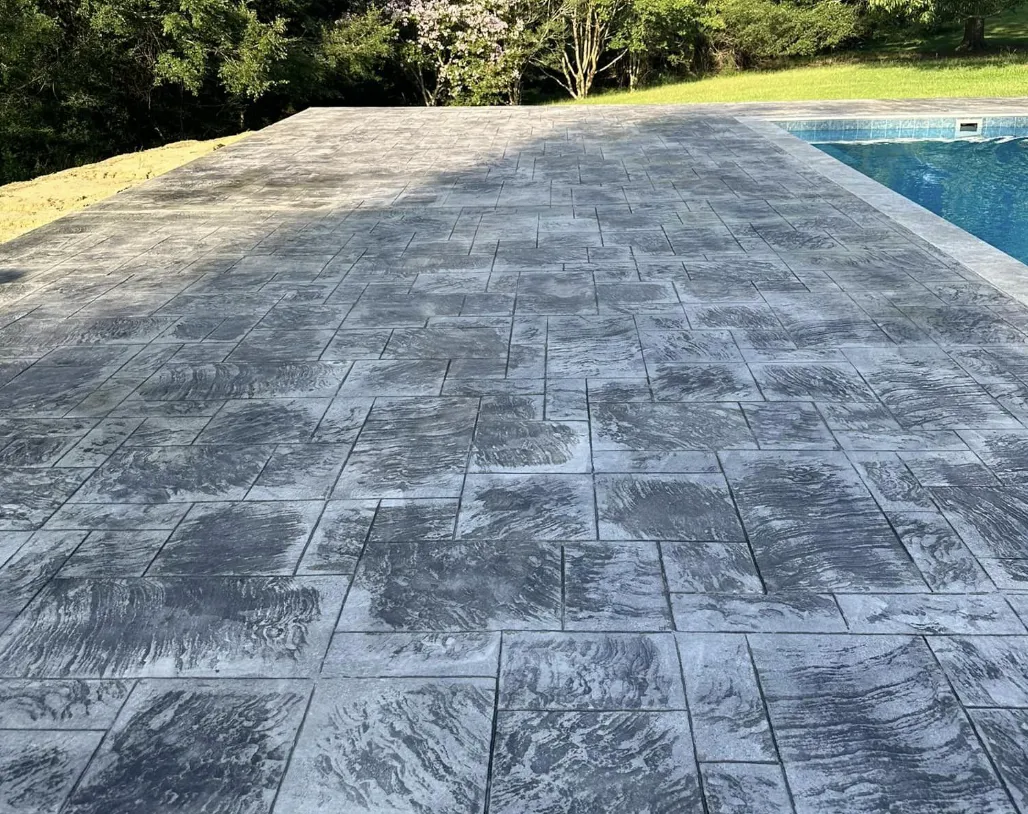
Concrete pool deck resurfacing for Tulsa heat, freeze-thaw, and red clay
A pool deck in Tulsa has to handle two very different seasons. These are the local conditions that decide what we put down and how we prep for it. Climate figures are National Weather Service Tulsa 1991–2020 normals from the NWS Tulsa climate summary.
Summer sun on bare feet
Tulsa's average July high is 93.6°F, and the city averages 74 days a year at or above 90°F. Dark surfaces soak that up, so for pool decks we steer toward light tans, sandstones and soft grays, sealed with a UV-stable sealer.
Freeze-thaw, November to March
Tulsa averages about 72 days a year at or below freezing, between an average first freeze of November 3 and last freeze of March 29. Water that sits in open cracks freezes and widens them, which is why cracks get repaired and the surface sealed before winter.
Red clay under the slab
Oklahoma's expansive clay swells when wet and shrinks when dry. Splash-out, overflow and lawn irrigation keep the soil at the edge of a pool deck wetter than the soil under the middle, and that uneven moisture is what lifts and cracks sections.
Chlorine and salt-water splash
With salt-chlorine generator pools, splash evaporates and leaves salt behind in pores, cracks and joints. Sealer failures on salt pools tend to start at control joints and where the slab meets the coping, so rinse the deck after heavy use and keep the joints sealed.
UV fade
Full sun breaks down sealer and dulls color over time. A UV-stable sealer, renewed on schedule, keeps a resurfaced deck from going chalky and slick again.
Traction in the splash zone
A sealed surface can turn slick when wet. A textured stamp pattern plus an anti-slip additive in the sealer keeps footing sure where kids run and wet feet land.
How our pool deck resurfacing works
The steps for resurfacing an existing deck with a stamped or textured overlay.
Inspect the Deck
We check for movement, hollow-sounding spots, crack widths, old coatings and the coping joint, then tell you whether it's a reseal, a resurface, or a replacement.
Repair & Prep
We remove loose coating and failed sealer, clean and profile the concrete, fill cracks and patch spalls, and keep the coping joint clear.
Overlay & Texture
We apply a bonding coat and a polymer-modified overlay, then stamp or texture your chosen pattern and carry the control joints through.
Color & Seal
We add a light, heat-friendly color and accents, then seal with a UV-stable sealer that has an anti-slip additive for the wet zone.
Pool deck resurfacing cost: what moves the number
We can't price a pool deck honestly without seeing it, because the biggest swing in cost is the part you can't see in a photo: how much repair and prep the existing surface needs. These are the things that move the price:
- Condition and prep. Stripping failed sealer, grinding off an old coating, filling cracks and patching spalls can cost as much as the new surface on a rough deck, or almost nothing on a clean one.
- The system you choose. A reseal costs far less than any resurfacing. Among resurfacing options, a stamped overlay costs more than a sprayed texture.
- Square footage and shape. Curves, steps, raised spa edges and narrow strips take more hand work per square foot than an open rectangle.
- Pattern and color. Multi-tone color, borders and detailed stamps add labor.
- Access and protection. Getting material into the backyard and protecting the water, equipment and landscaping all take time.
Resurfacing vs. tearing out and re-pouring
Tear-out adds demolition, haul-off, base work and a full-depth pour. Resurfacing skips all of it, which is why it costs less on a sound slab. As a general national reference, the Concrete Network's pool deck resurfacing guide says resurfacing "starts at $3-$5 per square foot, compared to $6-$10 per square foot for a new pour," with prices rising as decorative options are added. Those are national starting points, not our quote for a Tulsa deck.
The math flips when the slab is moving. Paying to resurface a heaving deck, then paying again to tear it out when the overlay cracks, costs more than replacing it once. If yours is in that shape, our stamped concrete pool deck page covers new pours, and the stamped concrete cost guide covers new-pour pricing. If the deck only needs a reseal, that's what we'll quote.
The real number comes from a free on-site estimate: we measure, check the deck, and price the fix it actually needs.
Pool deck resurfacing questions
Yes, if the cracks are stable. Hairline and shrinkage cracks get cleaned out and filled, spalls get patched, and control joints are carried through the new surface. Cracks that are still moving, offset, or wider than about a quarter inch point to a slab or base problem, and an overlay over them will crack again. Those sections need to be fixed or replaced first.
Not over a coating that is coming loose. We remove loose and hollow-sounding coating, grind down to sound concrete, repair cracks, and bond the overlay to the slab itself. If your existing cool-deck coating is still well bonded and you like it, a recoat by a coating applicator is usually the cheaper option.
It shouldn't be either. We use a textured stamp pattern and an anti-slip additive in the sealer for wet-area grip, and light colors that stay more comfortable underfoot than dark concrete in a Tulsa summer. Any sealed surface gets slicker as the sealer wears, so resealing on schedule matters.
Your pool contractor. That flexible expansion joint, loose coping and the tile line are part of the pool, not the deck. Have them handled before resurfacing; we stop the new surface at the joint rather than bridging it.
On a sound slab, usually yes, because resurfacing skips demolition, haul-off, base work and a full new pour. On a slab that is heaving or failing, it isn't, because the overlay will crack with the slab and you end up paying twice. A reseal costs less than either if that's all the deck needs.
When the concrete is sound and the complaints are faded color, a chalky look, or a slick feel when wet. Those are signs of worn-out sealer, and a cleaning plus a fresh anti-slip sealer coat fixes them for a fraction of the cost of a new surface. Our maintenance guide covers cleaning and resealing in detail.
Not sure if your deck needs resurfacing?
We'll come out, check the slab, cracks, old coating and coping joint, and give you a straight answer and a firm price, even when that answer is "just reseal it." Serving Tulsa and the surrounding metro. Check our standing on the Better Business Bureau.