
Design guide · Tulsa & the surrounding metro
Stamped Concrete Patterns and Colors for Tulsa Homes: How to Choose
Every stamped slab comes down to three choices: the pattern pressed into it, the way the color is built, and the shades you pick. Most regrets start with a photo chosen for the look alone. This guide sorts the options by how they live on a patio, driveway, walk or pool deck in Oklahoma weather.
Which stamped concrete pattern fits your project?
These are the pattern families we stamp, from the stone looks to brick, wood and plain texture. Exact stamp names vary from one stamp maker to the next, so judge the shape, joint lines and texture rather than the name.
| Pattern family | The look | Where it works best | Texture and practicality |
|---|---|---|---|
| Ashlar slate (cut stone) | Squares and rectangles of dressed stone in mixed sizes, with a slate-cleft surface | Patios, pool decks, walks and driveways; suits most house styles | Moderate texture. Straight, regular joints give control joints somewhere to hide. |
| Cobblestone | Small, rounded old-world stones set tight | Driveways, entries and borders | The most joints in a given area and the bumpiest surface. Rough on bare feet and wheels, and the joints hold grit. |
| Random stone and flagstone | Irregular natural stone shapes with wandering joints | Patios, pool decks and garden paths | The most natural look. A straight control joint shows clearly across the irregular stones. |
| Seamless texture skins | Stone or slate surface texture with no grout lines, often framed by tooled or saw-cut lines | Pool decks, large modern patios, walks that need to roll smoothly, borders | Smoothest to walk, roll and clean. With no grout lines, any random crack has nowhere to hide. |
| Brick: running bond, herringbone, basket-weave | Clay brick laid in a classic bond | Brick houses, walkways, driveway aprons and borders | Shallow, regular joints. Herringbone gets busy over a big area; running bond stays calm. |
| Wood plank | Long boards with grain, knots and end seams | Patios and deck-style areas off the back of the house | Grain texture without splinters or rot. Plank seams run one direction, so the layout needs planning around the house. |
| Large tile and squares | Big, flat-faced tiles in a grid | Contemporary houses, covered patios, commercial walks | Flattest of the patterned options. A grid sized to the joint spacing hides control joints well. |
| Borders and bands | A soldier course, a smooth band, or a contrasting color around the field | Framing any pattern, driveway edges, pool surrounds | A smooth band gives a clean edge for chair legs and shovels. A second color adds labor. |


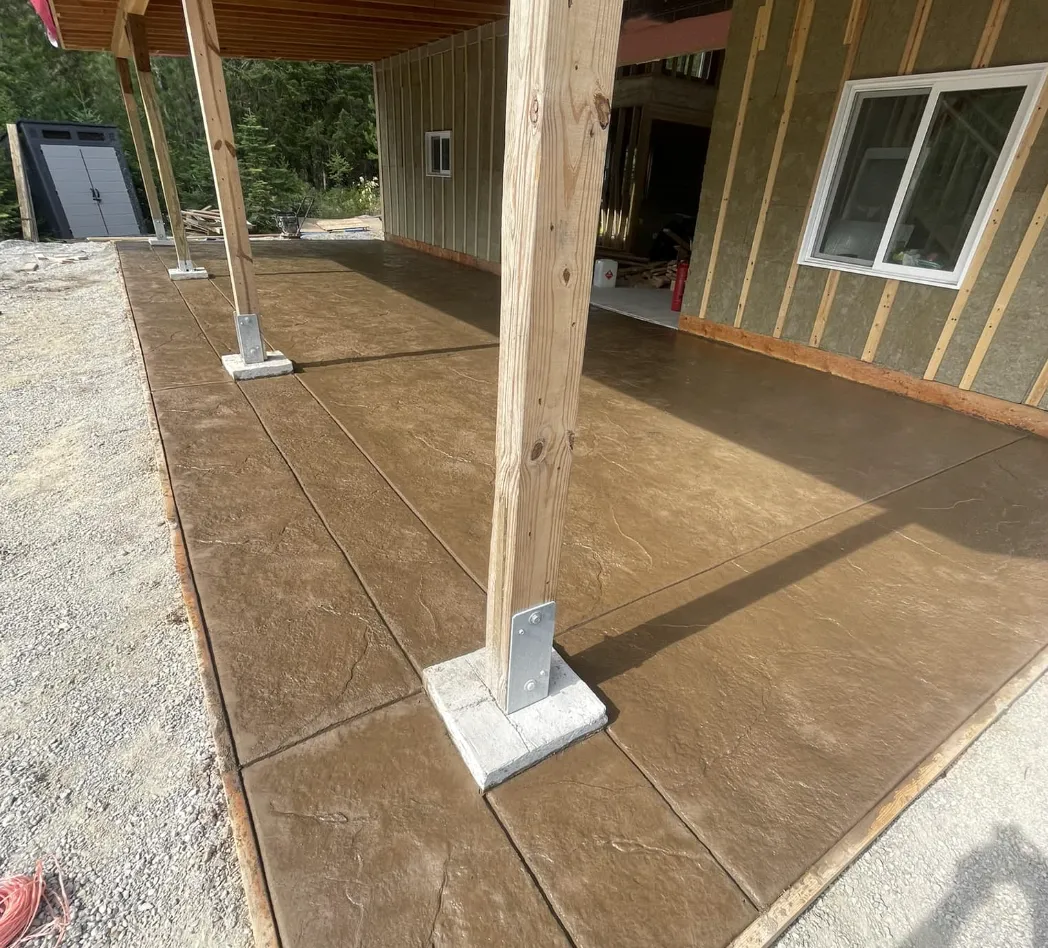
Stock photos, shown for pattern type and color only.
Ashlar slate, flagstone and cobblestone stamp patterns
The three stone looks differ mostly in their joints. Ashlar slate has straight joints in a loose grid, so it reads as tidy and fits almost any house. Flagstone and random stone have curving, irregular joints that look the most like real stone, which is why patios and pool decks lean that way. Cobblestone packs the most joints into the least space. It looks great on an entry or as a border, but over a whole patio that's a lot of grooves to sweep and a lot of bumps under a chair leg.
Seamless texture stamps: stone surface without grout lines
A seamless skin presses a stone or slate surface texture into the concrete with no joints at all. It's the quietest stamped finish and often the best one for pool decks and walks. Here's the trade-off nobody puts in the brochure: grout lines are where a pattern hides its control joints and, sometimes, its cracks. On a seamless surface, joint lines have to be planned as part of the design, like the straight panel lines in the brown slab above. A random crack will show more than it would in a busy stone pattern.
Brick, wood plank and tile stamp patterns for straight-lined houses
Brick, plank and tile patterns are geometric, so they line up with walls, steps and doors. That's their strength and their risk. A herringbone or plank layout that runs a few degrees off the back wall of the house looks wrong from the kitchen window, so the starting line matters more than the stamp. Running bond brick ties a walk into a brick house without much visual noise. Large tiles suit modern houses and covered patios where you want something flatter.
Stamped borders and bands: where a second color earns its keep
A border is the cheapest way to make a simple pattern look designed. A smooth or brick-pattern band in a slightly darker shade frames the field, gives the edges a clean line for shoveling and furniture, and visually ties a patio to a walk or a driveway to the street. If your budget allows one extra, a border usually does more than a fancier field pattern.
Integral color vs color hardener: how stamped concrete gets its color
Stamped color is built in layers: a base color, an accent color from the release, and the sealer on top. Each layer sits in a different place, so each one wears differently. On our work the base is integral color or a color hardener, the accent is an antiquing release, and the finish is a matte or low-sheen sealer, chosen to suit the look you want.
| Color layer | Where the color sits | Range and intensity | How it wears | The catch |
|---|---|---|---|---|
| Integral color (base) | Mixed into the whole load, so it runs all the way through the slab | Softer earth tones, less intense than a hardener | Surface wear and chips show the same color underneath | Color can shift slightly between truckloads on big pours |
| Dry-shake color hardener (base) | Broadcast onto the wet surface and troweled into the top layer | Wider palette, brighter and more intense color | Harder, more wear-resistant surface, but a deep chip can show gray concrete | More labor, and dusty to apply on a windy day |
| Powder release (accent) | Pressed into the surface paste, mostly in the low spots of the texture | The most accent colors to choose from | The first color to wear off high points and traffic edges | Dust on application, and too dark a powder is hard to remove once sealed |
| Liquid release (accent) | A thin film that mostly evaporates; clear unless tinted | Clear shows the base color only; tinted gives a softer accent | Little or no accent to wear | Less contrast and depth than powder |
| Tinted sealer (top) | In the clear coat on the surface | A translucent wash over everything | Wears away with the sealer | Color has to be renewed with each recoat |
| Clear sealer, gloss or matte (top) | On the surface | Gloss deepens color and adds a wet look; matte reads closer to natural stone | Color looks dull and dusty when it wears thin | Gloss shows glare in full sun; every sealer needs periodic recoating |
Integral color: stamped concrete colored all the way through
With integral color the pigment goes into the concrete itself. The Concrete Network's integral color overview says the batch is "colored all the way through," that "even if surface abrasion occurs, the color will not wear away," and that the pigments "won't fade over time from exposure to the weather or ultraviolet light." The same page is honest about the limit: the hues are "subtle and less intense than what you can achieve with color hardeners," and the palette is mostly "soft earth tones."
The other catch is consistency. A Concrete Decor column on coloring stamped concrete calls integral color "the hands-down favorite among stamped concrete installers" but warns of "the possibility of color inconsistency, especially on larger jobs," because any variation in the gray base concrete carries into the finished color. Pigment maker Solomon Colors' dry integral color specification says consistent color "can only be achieved by using the same mix design throughout the job."
Dry-shake color hardener: a stronger, brighter stamped surface
A color hardener is a blend of cement, fine sand and pigment spread over the wet slab and troweled in. The color stays concentrated in the top layer, so it's richer, and the surface gets harder. The Concrete Decor column puts the gain in surface strength at "as much as 1,500 psi." Its trade-offs are just as specific: if the concrete is chipped, "the underlying gray concrete color" can show through, and the hardener "can be a dusty mess if the wind is blowing," which on an open Oklahoma lot is a real consideration.
Powder vs liquid release and the antiquing accent color
Release keeps the stamp mats from sticking to the fresh concrete, and colored release is what puts the darker accent in the joints and low spots. The Concrete Network's release agent guide says powders "offer more color selections," and that "about 70% to 80% of the release is washed away after the concrete hardens." It also warns that "once the concrete is stamped and sealed, it can be very hard to remove the release powder if the color is too dark." That's why we'd rather go a shade lighter on the accent than a shade darker. Liquid release is cleaner and usually clear, which suits a one-color look or stamping near a pool.
Tinted vs clear stamped concrete sealer, gloss vs matte
The sealer changes how every color underneath reads. A gloss finish deepens the color and gives the slab a permanently wet look. A matte or low-sheen finish reads closer to real stone and throws less glare in full sun. A tinted sealer adds a translucent wash of color, but that color lives in the coat and goes when the coat wears. When you look at samples, look at them sealed in the finish you're choosing. Routine recoating is covered in our stamped concrete cleaning and sealing guide.
What stamped concrete colors work best in Tulsa sun, heat and red dirt?
Tulsa summers are long and hard on surfaces. Under the National Weather Service's 1991–2020 normals in its Tulsa climate summary, the average July high is 93.6°F, with about 74 days a year at or above 90°F and about 11 at or above 100°F. That sun affects three color decisions.

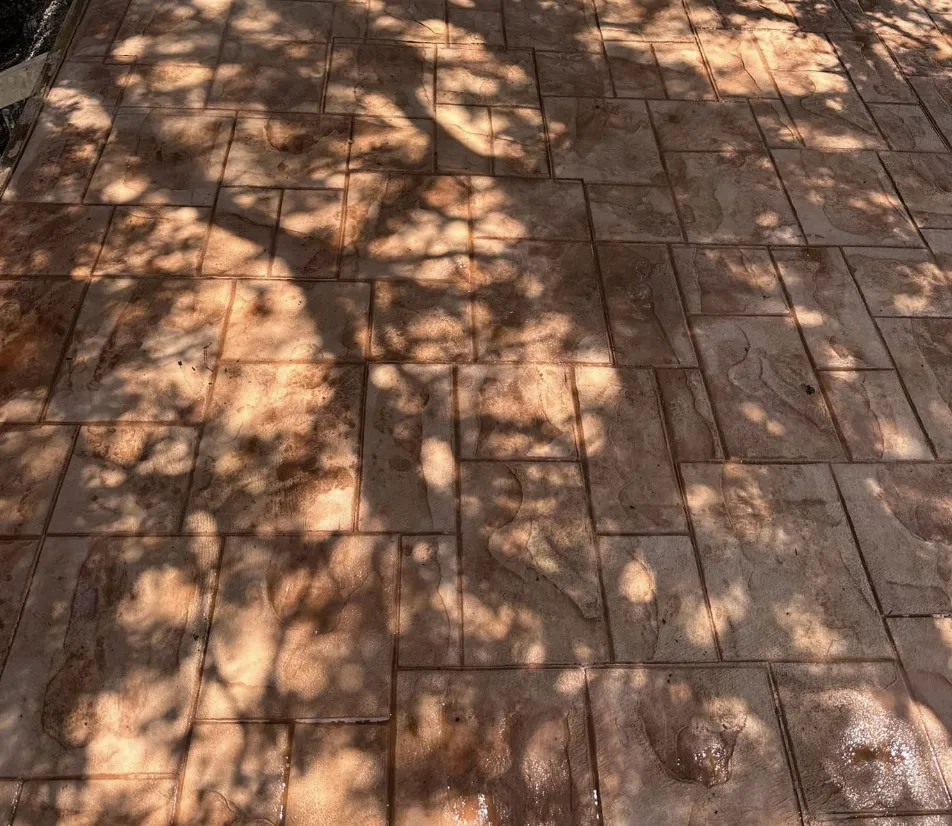

Stock photos, shown for color only.
Light vs dark stamped concrete colors around pools and patios
Darker surfaces absorb more sun and run hotter. The EPA's cool pavements page describes cooler paving as material that reflects more solar energy so it stays cooler than conventional pavement. On a pool deck or a west-facing patio, that's the difference between a deck you can cross barefoot in July and one you can't. Our pool deck color advice follows from it: light tans, sandstones and weathered grays. Save charcoal and deep brown for shaded areas, borders, or surfaces nobody walks on barefoot.
Which stamped concrete colors hide Oklahoma red dirt
This is practical observation, not a lab result. Red clay washed out of flower beds and tracked in on shoes and tires shows up as a rusty film on light gray and near-white stamped concrete. On charcoal, dry dust shows as a pale haze. Tans, browns, terracotta and multi-tone stone blends hide both. That's a big reason earth tones are the colors Tulsa homeowners pick most, and why a busy driveway or a patio next to a bed of bare soil is a poor place for the lightest or darkest shade.
How UV exposure should shape your stamped concrete color choice
Integral pigments in the base color are sold as fade-resistant. What wears in the sun is mostly the sealer and the accent release on high points, and the slab looks washed out as they go. Two things follow. First, a design that relies on strong contrast between the base and the accent will lose more of its look between reseals than a design with a gentle accent. Second, very dark grays deserve extra caution. Solomon Colors' specification notes that carbon black, the pigment behind charcoal shades, "has a tendency to dissipate out of concrete over time" and recommends a proper sealer maintenance program to slow it. If your existing slab has already faded, that's a different problem; our guide to faded, cracked or peeling stamped concrete covers it.
How do you match stamped concrete colors to your house?
Pick from what won't change: the brick, the stone veneer, the roof and the trim. Paint and plants change; the slab and the brick will be there together for decades. We can match your brick, trim, stone or roof, and the usual approach is to pick up a color that's already there rather than add a new one. A near-miss of your brick red usually looks worse than a tan that picks up the mortar.
| If the house has | Base color to start from | Accent release | Why it works |
|---|---|---|---|
| Red or orange brick | Buff, sandstone or light tan | Medium brown | Picks up the mortar and the darker brick flecks without competing with the brick |
| Tan or cream stone veneer | Desert tan or warm gray | Brown or soft charcoal | Reads as the same family of stone, a shade apart |
| Gray, white or blue siding with a dark roof | Light to medium gray | Charcoal, kept light | Echoes the roof without making the whole slab dark |
| Dark brick or a dark painted house | Medium gray or medium brown | A shade darker than the base | Too light a slab can glare against a dark house |
| A pool with light coping | Light tan or light gray | Soft, low-contrast | Stays cooler barefoot, and a gentle accent shows less wear around the water |
These are starting points, not rules. Two colors, one base and one accent, cover most good-looking jobs. A third color or a contrasting border adds work, and design complexity is one of the main things that moves the price; our stamped concrete cost guide for Tulsa explains how pattern and color count affect the number.
Which stamped patterns are practical for pool decks, driveways and walkways?
A pattern that looks right in a photo can be wrong for the job. Here's how texture and joints play out where you'll actually use the slab.
Deep texture vs bare feet on a stamped pool deck
Deep stone textures and heavy cobblestone feel rough on bare feet and hold more grit and leaves. Seamless skins, slate textures and flatter stone patterns are kinder underfoot and still give grip. In the wet zone we add a clear traction additive to the sealer. Pair a gentle texture with a light color and the deck stays usable all summer. See our stamped concrete pool deck page for new pool deck pours.
Snow shovels and ice on a stamped driveway texture
Tulsa does get ice and snow, and a shovel blade catches on every deep joint and rounded cobble. A plastic-edged shovel and a moderate pattern like ashlar slate or running bond brick make winter easier. A smooth border band along the edges gives the blade somewhere clean to run. Our stamped concrete driveway page covers how we build driveways for the load.
Wheelchairs, walkers and strollers on stamped walkways
For anyone using wheels, joint depth matters more than looks. The 2010 ADA Standards apply to public facilities, not private homes, but they're a useful benchmark: surfaces should be "stable, firm, and slip resistant," changes in level up to ¼ inch may be vertical, and openings shouldn't pass a ½-inch sphere (U.S. Access Board). Seamless texture, large tile or a smooth center band with a pattern on each side roll best. See our stamped concrete walkway page.
Control joints and cracks inside a stamp pattern
Every slab needs control joints, and the pattern decides whether you notice them. The American Society of Concrete Contractors' bulletin on jointing decorative concrete says joints "can sometimes be hidden in grout lines of the decorative concrete pattern if the lines are roughly parallel," while on random patterns "joint location will be more obvious." We place joints to blend with the pattern wherever the layout allows. No pattern hides a crack perfectly, and the same bulletin says "some random cracking should be expected."
How to choose stamped concrete patterns and colors you won't regret
- Start with how the slab gets used. Bare feet, tires, shovels or wheels rule out some textures before looks come into it.
- Pick colors from the house, not from a screen. Brick, stone and roof first. Screens and printed charts shift color.
- Look at physical samples in your own light. We bring samples to the estimate. Look at them in morning shade and late-afternoon sun, and wet one: the color when wet is close to how it reads under a fresh glossy sealer.
- Treat color charts as a starting point. Final color depends on the concrete mix, finishing and sealer. Solomon Colors "strongly recommends the use of test slabs to determine final color outcome," and the ASCC bulletin says a mock-up should include a sample joint. On a big or hard-to-picture job, that's worth raising at the estimate.
- Ask where the control joints will go. In a random stone pattern they'll show; in ashlar or tile they can often follow the joint lines.
- Count the colors. One base and one accent cover most jobs. Add a border before you add a third color.
What we'd tell you at the estimate, even though it costs us: a simple seamless texture or a single-pattern, two-color design often looks better than a busy multi-color one, and it costs less. Deep-relief patterns are harder to clean and less comfortable barefoot. Release color wears first on steps, edges and traffic lanes, and it needs regular resealing to keep its contrast. And no pattern hides a crack completely.
Already have stamped concrete and want a different pattern or color on top? That's a stamped concrete overlay over sound concrete. For how patterns and colors look across the whole decorative range, including stains, see our decorative concrete services.
Pattern & Color Estimate
Tell us what you're paving and the look you have in mind. We'll bring samples to the estimate.
Thanks — request received!
We'll reach out shortly about your stamped concrete project. For anything urgent, call (918) 505-7730.
Stamped concrete pattern and color questions
It depends on what you're paving. For driveways and entries, cobblestone and ashlar are what Tulsa homeowners ask us for most. On patios and pool decks, slate and flagstone textures lead. Popular isn't the same as right for your slab, so check the practicality notes for your use first.
Neither wins everywhere. Integral color runs through the whole slab, so wear and chips show the same color, but the palette is softer and color can vary between truckloads on big pours. A color hardener gives brighter color and a harder surface, but a deep chip can show gray concrete and it takes more labor. Soft earth tones suit integral color; strong or unusual colors usually need a hardener.
Usually two: a base color and a darker accent from the release. That's enough for depth and shadow in the texture. A contrasting border is a better third element than a third color across the whole field, and fewer colors keep the cost down.
Lighter colors. Surfaces that reflect more sunlight stay cooler, so light tans, sandstones and light weathered grays are the comfortable choices for bare feet in a Tulsa summer. Charcoal and deep browns absorb the most heat. A gentle texture helps comfort too.
No. Pattern names come from each stamp maker's catalog, and similar looks carry different names from one maker to the next. When you find a pattern you like, compare the actual stamp or a photo of it on a finished slab, not just the name.
Yes. Design complexity is one of the main price drivers: more colors, intricate patterns and custom borders add labor. A single pattern with one base color and one accent is the economical end. Our Tulsa stamped concrete cost guide explains the ranges.
If the slab is sound and not moving, a stamped overlay can put a new pattern and color on top of it. If you only want to freshen faded color, start with our stamped concrete repair guide, because a reseal or a recolor may be all it needs.
Sources: National Weather Service Tulsa, Tulsa climate normals 1991–2020; U.S. EPA, Using Cool Pavements to Reduce Heat Islands; U.S. Access Board, 2010 ADA Standards §302–303; American Society of Concrete Contractors, Jointing and Crack Control in Decorative Concrete Applications; Solomon Colors, Dry Integral Colors technical specifications; The Concrete Network, integral color and release agents; Concrete Decor, How should you color your stamped concrete?
See the patterns and colors in person
Get a free on-site estimate for stamped concrete in Tulsa or the surrounding area. We'll look at your space and your house, bring physical samples, and give you a firm price.